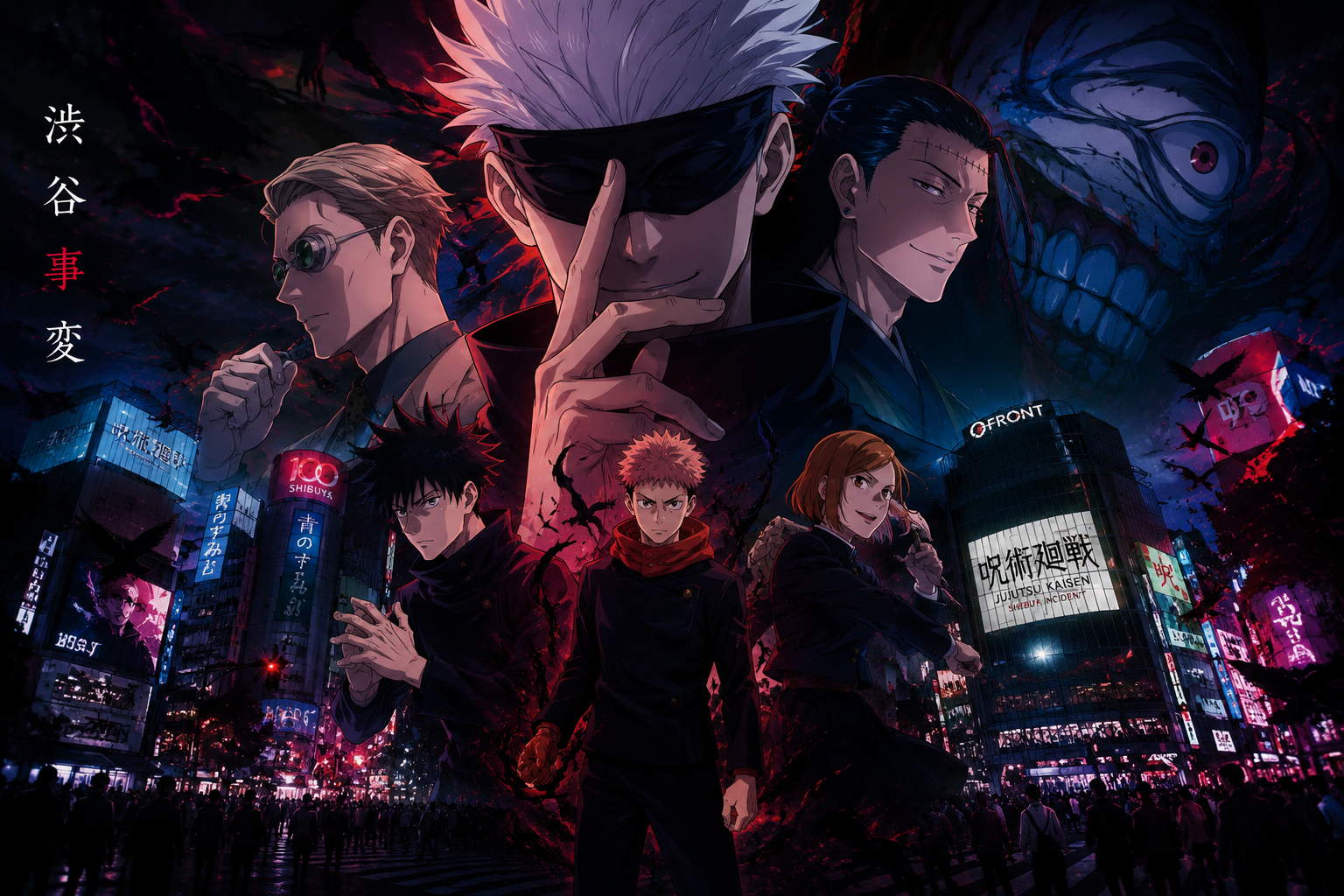
Jujutsu Kaisen Season 2: The Shibuya Incident - A Complete Breakdown
The Shibuya Incident Arc isn’t just the best arc in Jujutsu Kaisen—it’s one of the most devastatingly effective storylines in modern anime. Over the course of 18 episodes, Gege Akutami systematically dismantles everything the series built, killing major characters, sealing the strongest sorcerer, and fundamentally altering the story’s trajectory. By the arc’s end, nothing is the same. The world of Jujutsu Kaisen has changed forever.
Season 2 of Jujutsu Kaisen delivers on every promise the series made. It deepens the lore, expands the cast, and pushes animation to unprecedented heights. But beneath the breathtaking action sequences lies something more profound: a meditation on sacrifice, purpose, and the terrifying cost of power. This isn’t just a shonen anime getting darker—it’s a story maturing into something genuinely complex and emotionally devastating.
Let’s break down exactly what makes this season so exceptional.
The Hidden Inventory Arc: The Tragedy of Youth
Why This Arc Exists
The Hidden Inventory Arc (Episodes 1-5 / Chapters 65-79) isn’t filler. It’s the emotional foundation upon which the entire Shibuya Incident rests. Without understanding who Gojo and Geto were, the tragedy of their separation loses its weight.
Akutami uses these five episodes to accomplish four critical objectives:
- Humanize Gojo Satoru before sealing him
- Explain Geto Suguru’s descent into villainy
- Establish the corruption of Jujutsu society
- Foreshadow the themes that will define the Shibuya arc
Gojo Satoru: The Birth of the Strongest
Young Gojo is almost unrecognizable from his adult self. Cocky, dismissive, and utterly convinced of his own superiority, he treats sorcery like a game. The Star Plasma Vessel mission—supposedly routine—forces him to confront reality.
Riko Amanai’s death is the pivot point. Gojo stood by as a girl he was sworn to protect was murdered. He was the strongest, and it meant nothing. His transformation into the protector we know—the teacher who fights for the next generation—begins at this exact moment.
The scene where Gojo stands over Riko’s body, his face eerily calm, is one of the series’ most powerful moments. This is the first time we see his mask slip. The pain is there, buried beneath layers of control. He never forgot this failure. It drove every decision he made afterward.
The irony is devastating: Gojo became the strongest sorcerer alive, but the one person he couldn’t protect defined his entire life.
Geto Suguru: The Fallen Idealist
Geto’s descent is arguably the arc’s most compelling element. He starts as an idealistic sorcerer who genuinely believes in protecting the weak. His friendship with Gojo is warm, playful, and authentic—two young men sharing a noble purpose.
But the mission changes him. The village where two young sorcerers were tortured and imprisoned by non-sorcerers—that’s where Geto breaks. He sees the absolute worst of humanity and concludes that non-sorcerers are the source of all evil.
The execution of the villagers is chilling because it’s methodical. Geto doesn’t kill out of rage or passion. He kills with cold certainty, believing he’s performing a necessary purification. His final conversation with Gojo, where he declares his new philosophy, is heartbreaking because he genuinely believes he’s doing the right thing.
The parallel to Eren Yeager is unavoidable. Both are idealists who witness such profound cruelty that they decide the only solution is mass murder. Both believe they’re saving their people. Both are wrong—and right at the same time.
Jujutsu Society’s Corruption
The Hidden Inventory arc also exposes the rot at the heart of Jujutsu society. The higher-ups are revealed as petty, self-serving, and willing to sacrifice anyone to maintain their power. Sorcerers are treated as tools. The system is designed to protect itself, not the people it’s supposed to serve.
This corruption is crucial context for the Shibuya Incident. When the disaster curses and Kenjaku attack, they’re exploiting existing fault lines. The system is already broken—they’re just accelerating the collapse.
This theme resonates beyond the anime. Institutions that claim to protect us often serve themselves. Power corrupts. The vulnerable suffer. Akutami doesn’t offer solutions—he simply exposes the reality.
The Shibuya Incident: Anatomy of a Cataclysm
The Plan in Full
Kenjaku’s plan is terrifying in its scope and precision. Every element serves a purpose:
- Seal Gojo Satoru using the Prison Realm
- Release Mahito to create chaos and chaos
- Unleash Sukuna by feeding Yuji enough fingers
- Absorb Mahito to access Idle Transfiguration
- Trigger the Culling Games to evolve humanity
- Create chaos to destabilize Jujutsu society
Each step builds on the last. The plan accounts for variables—Toji’s resurrection, Mechamaru’s betrayal, the arrival of Yuki Tsukumo. Kenjaku adapts constantly, using every setback as an opportunity.
What makes Kenjaku terrifying isn’t his power—it’s his patience. He’s been planning this for centuries. He’s lived multiple lives, possessed multiple bodies, and watched civilizations rise and fall. He doesn’t rush. He waits for the perfect moment.
Gojo’s Sealing: The Moment Everything Changed
Episode 9’s climax—Gojo’s sealing—is the season’s single most consequential moment. Everything that follows is a direct consequence of this event.
The strategy is brilliant in its simplicity:
- Kenjaku (in Geto’s body) appears before Gojo
- Gojo hesitates because it’s his best friend’s face
- That split second of hesitation allows Prison Realm to activate
- Gojo is sealed for all eternity
Why the plan works: Gojo’s emotional vulnerability is his only weakness. Kenjaku exploits it perfectly. The strongest sorcerer in the world is defeated not by power, but by love.
The aftermath is immediate and devastating:
- Sorcerers lose their greatest asset
- Disaster curses gain freedom of movement
- Chaos erupts across Shibuya
- Civilians die by the thousands
Gojo’s sealing represents the moment the series’ power structure collapses. Without him, the villains can operate without restraint.
The Battles That Defined the Arc
Yuji and Nobara vs. Mahito and the Cursed Womb
This battle showcases the series’ combat philosophy at its best. Yuji and Nobara work in perfect synchronization, combining their abilities to counter Mahito’s soul-manipulation. The choreography is fluid, creative, and emotionally charged.
What makes the fight effective:
- The teamwork feels earned
- The strategy is logical and clever
- The stakes are personal and immediate
- The animation matches the manga’s intensity
Megumi vs. Toji Fushiguro
Toji’s return is one of the season’s most shocking moments. Resurrected by the cursed womb’s technique, he’s initially just a mindless weapon. But when he sees Megumi, something shifts.
Toji’s humanity surfaces briefly: He recognizes his son, remembers his name, and makes a conscious choice. He prioritizes Megumi’s survival over his own programming.
The animation conveys Toji’s nature perfectly: Every movement is efficient, brutal, and instinctive. No wasted motion. No flashy techniques. Just raw, overwhelming physical power.
Sukuna vs. Mahoraga
This sequence will be studied by animators for years. Sukuna’s battle against the Ten Shadows’ ultimate summon is visually breathtaking—and thematically significant.
What makes it exceptional:
- The choreography is unprecedented in its creativity
- The visual effects push animation boundaries
- The scale is epic without losing intimacy
- Sukuna’s character is deepened through his actions
Sukuna reveals his nature: He’s not just powerful—he’s cruel. He orchestrates Mahoraga’s death with theatrical flair, prioritizing entertainment over efficiency. His Domain Expansion, Malevolent Shrine, is rendered as both terrifying and beautiful.
Yuji vs. Choso: The Blood Brothers
This is the arc’s most emotionally resonant battle. Choso, realizing that Yuji is his brother, makes a choice that redefines his character. What starts as a brutal fight transforms into something more profound.
The themes are powerful:
- Family transcends ideology
- Even villains can change
- Bonds formed in battle can be meaningful
- Love can survive violence
Choso’s transformation is credible because it’s gradual. He doesn’t switch sides instantly. He struggles. He doubts. He makes the choice because it’s right, not because it’s easy.
Nanami Kento’s Final Stand
Nanami’s death is the arc’s most heartbreaking moment. His final fight against Mahito is brutal, desperate, and ultimately hopeless. But his last moments—seeing Yuji, giving him one final piece of advice—are deeply moving.
Why Nanami’s death hits so hard:
- He was a mentor figure
- He was the voice of realism
- He kept fighting despite impossible odds
- He died protecting Yuji
Nanami represented the series’ moral center: He was practical, hardworking, and fundamentally decent. His death signals that the world is changing—and not for the better.
Nobara Kugisaki’s Fate
Nobara’s “death” (the ambiguity is intentional) is brutal in its suddenness. She’s one of the core trio, the team’s emotional heart. Her loss changes the group dynamic forever.
Yuji’s scream is one of the series’ most affecting moments: He’s already lost so much. He’s already carrying so much guilt. Losing Nobara pushes him to the breaking point.
The ambiguity is cruel but effective: We’re left wondering. Is she alive? Will she return? The uncertainty makes the loss feel more present and painful.
Character Development: The Arc’s Emotional Core
Yuji Itadori: The Breaking of a Protagonist
Yuji starts Season 2 as a cheerful, determined young man. He ends it as a broken shell of himself—a survivor who has seen too much, lost too much, and stopped wanting to live.
His transformation is earned:
- He discovers his existence was engineered for suffering
- He watches his mentors die
- He loses his closest friend
- He bears responsibility for Sukuna’s carnage
- He’s forced to confront the meaninglessness of his struggle
The final scene—Yuji staring at Mahito’s defeated form—is devastating. He’s not triumphant. He’s hollow. He’s achieved his immediate goal and feels nothing.
This is the series’ most radical choice: Yuji isn’t becoming stronger through adversity. He’s becoming more damaged. His mental state will define the Culling Games arc.
Gojo Satoru: The Paradox of Power
Gojo’s greatest strength—his overwhelming power—is also his greatest weakness. He’s so strong that he’s unable to form genuine connections. He’s isolated by his own abilities.
His sealing is a brilliant narrative choice:
- It removes the plot’s ultimate safety net
- It forces other characters to grow
- It highlights the vulnerability beneath his confidence
- It raises the stakes permanently
Gojo’s absence is felt throughout the arc: Every victory is hollow. Every survival is temporary. The world feels less safe without him.
Mahito: The Perfect Villain
Mahito is the arc’s primary antagonist, and he’s terrifying because he’s both powerful and unhinged. He doesn’t care about ideology or strategy—he just wants to cause suffering.
What makes Mahito effective:
- His powers are genuinely unsettling
- His philosophy is coherent (if monstrous)
- He forces characters to confront difficult choices
- His victories feel earned, not arbitrary
Mahito’s defeat isn’t triumphant—it’s exhausting. Yuji and others have to destroy him by eroding his soul over time. It’s not a heroic victory; it’s a grim, necessary task.
The Supporting Cast
Maki Zenin: Her role in the arc is crucial but understated. She emerges as a powerful fighter, continuing her journey toward becoming one of the series’ strongest characters.
Mei Mei: Her pragmatic approach to sorcery—prioritizing profit—is refreshingly honest. She’s not a hero; she’s a professional.
Yuki Tsukumo: A mysterious figure who plays a key role in helping Yuki survive. Her philosophy about breaking the cycle of curses and sorcerers is central to the series’ themes.
Animation and Direction: MAPPA’s Masterpiece
The Technical Achievement
MAPPA’s work on Season 2 is nothing short of extraordinary. The studio has consistently pushed animation boundaries, but this season represents a quantum leap forward.
Key achievements:
- Fluid animation that captures combat intensity
- Creative visual effects that match the manga’s style
- Emotional subtlety in quieter moments
- Consistent quality across 18 episodes
The budget is visible in every frame: This isn’t rushed animation. This is a labor of love.
Standout Sequences
Gojo’s Domain Expansion: Rendered as a cosmic landscape that overwhelms the senses. The scale is breathtaking.
Sukuna’s Domain Expansion: Malevolent Shrine combines sacred imagery with brutal destruction. The juxtaposition is peak Akutami.
Yuji and Nobara’s synchronized attacks: The fluidity and precision demonstrate MAPPA’s mastery of action choreography.
The rainy scenes: Atmospheric and melancholic, they elevate emotional moments.
The Soundtrack
The musical score deserves special mention. Composed by Hiroaki Tsutsumi and others, the soundtrack enhances every scene without overpowering it.
Standout tracks:
- “Hidden Inventory” - melancholic and reflective
- “Shibuya Incident” - urgent and menacing
- “Gojo’s Theme” - triumphant but lonely
- “Nanami’s Theme” - weary but determined
Themes and Symbolism: The Deeper Meaning
The Meaning of Strength
Jujutsu Kaisen consistently explores what it means to be strong. Season 2 offers multiple perspectives:
- Gojo: Strength is protecting others
- Sukuna: Strength is absolute domination
- Yuji: Strength is never giving up
- Nanami: Strength is doing your duty
The series doesn’t privilege one definition: Instead, it shows the consequences of each approach.
The Fragility of Systems
Jujutsu society is broken—corrupt, inefficient, and cruel. The Shibuya Incident exposes this fragility:
- Higher-ups sacrifice their own people
- Cover-ups and lies fester
- The system protects itself, not others
- The collapse is inevitable
The series’ message is unambiguous: Institutions fail. Those who rely on them will be disappointed.
The Necessity of Failure
Season 2 teaches us that failure is inevitable:
- You can be the strongest and still lose
- You can fight with everything and still be defeated
- You can do everything right and still fail
This isn’t nihilism—it’s realism: Acknowledging failure is the first step toward growth.
The Cost of Purpose
The arc explores why people fight:
- Yuji fights because he wants to help others
- Nanami fights because it’s his job
- Geto fought because he believed in protecting the weak
- Kenjaku fights because he’s curious about evolution
Each character’s purpose defines them: And determines their fate.
The Aftermath: Consequences That Last
The Culling Games Setup
The Shibuya Incident isn’t an ending—it’s a beginning. Kenjaku’s plan succeeds. The Culling Games are triggered. Japan becomes a battlefield where sorcerers fight to the death.
The consequences are permanent:
- Gojo is sealed indefinitely
- Yuji is traumatized and broken
- Nobara’s fate is uncertain
- The world is forever changed
The Culling Games Arc
Season 3 will cover the Culling Games arc, where:
- New rules are established
- New characters are introduced
- The stakes are raised even further
- The series enters its final phase
The Shibuya Incident is the series’ turning point: After this, nothing is ever the same.
Critical Reception and Impact
Why the Arc Resonates
The Shibuya Incident arc works because it’s emotionally honest:
- Characters die and stay dead
- Injuries have permanent consequences
- The world doesn’t go back to normal
- Hope is a luxury, not a guarantee
The arc respects its audience: It doesn’t offer easy answers or cheap victories.
Comparisons to Other Series
Chainsaw Man: Both series feature brutal, emotionally devastating arcs that change everything.
Attack on Titan: The Shibuya Incident shares the Rumbling’s thematic weight—violence has consequences, and there are no heroes.
Fullmetal Alchemist: Both series explore the cost of power and the weight of sacrifice.
Final Verdict
Rating: 9.8/10
Jujutsu Kaisen Season 2 isn’t just great anime—it’s essential viewing. It pushes animation forward, deepens characters, and tells a story of genuine emotional weight.
Strengths:
- Animation is breathtaking
- Character development is nuanced
- The narrative is thematically coherent
- The emotional stakes are genuine
Minor weaknesses:
- Some pacing issues in the middle episodes
- Certain plot points feel rushed
- Some supporting characters are underutilized
The arc achieves everything it sets out to do: It challenges its audience, refuses easy answers, and suggests that sometimes, winning means losing everything.
Frequently Asked Questions
What is the Shibuya Incident Arc about?
The Shibuya Incident Arc is the Jujutsu Kaisen’s darkest and most significant storyline. It follows the aftermath of Gojo Satoru’s sealing as disaster curses and villains wreak havoc in Shibuya. The arc features intense battles, major character deaths, and permanent consequences for the series.
Who dies in the Shibuya Incident?
Nanami Kento dies in the battle against Mahito. Nobara Kugisaki’s fate is ambiguous—she’s severely injured but not explicitly shown dead. Many unnamed sorcerers and civilians die throughout the arc.
Why was Gojo sealed?
Gojo was sealed in the Prison Realm by Kenjaku, who exploited his hesitation when he saw Geto Suguru’s face. The sealing removes the series’ most powerful character from play, allowing the villains to succeed.
What is the Culling Games?
The Culling Games is Kenjaku’s ultimate plan—a death game where sorcerers battle for evolution and supremacy. The Shibuya Incident triggers this event, setting the stage for the series’ next arc.
Is the Shibuya Incident arc in the manga?
Yes, the Shibuya Incident arc covers Chapters 79-137 of the Jujutsu Kaisen manga. The anime adaptation faithfully recreates the manga’s events.
What happens to Yuji after the Shibuya Incident?
Yuji is traumatized and broken. He’s forced to confront his purpose and whether he wants to continue living. His mental state will be a major focus of the Culling Games arc.
Final Thoughts: The Legacy of Shibuya
Jujutsu Kaisen Season 2 is a landmark achievement. It takes a beloved series and elevates it to new heights—thematically, visually, and emotionally. The Shibuya Incident arc isn’t just about battles; it’s about sacrifice, the cost of power, and the meaning of purpose.
What makes the arc enduring:
- Its refusal to compromise
- Its honest portrayal of trauma
- Its willingness to kill major characters
- Its confidence in leaving questions unanswered
Akutami created a world where no one is safe, where heroism has a cost, and where even the strongest can fail. The Shibuya Incident is the series’ statement of intent—a declaration that Jujutsu Kaisen will not be another shonen anime that plays it safe.
The arc’s message is clear: Hope isn’t guaranteed. Victory isn’t permanent. The struggle is what matters.
What did you think of the Shibuya Incident arc? Which moment hit you the hardest? Let me know in the comments. I’d love to hear your perspective.
About the Author
A passionate analyst of anime and storytelling, I’ve spent years dissecting the works that challenge and inspire. Jujutsu Kaisen is one of the most significant narratives of the modern era—a series that forces us to confront uncomfortable truths about violence, purpose, and the meaning of strength. If you share that fascination, feel free to reach out. The conversation is just beginning.