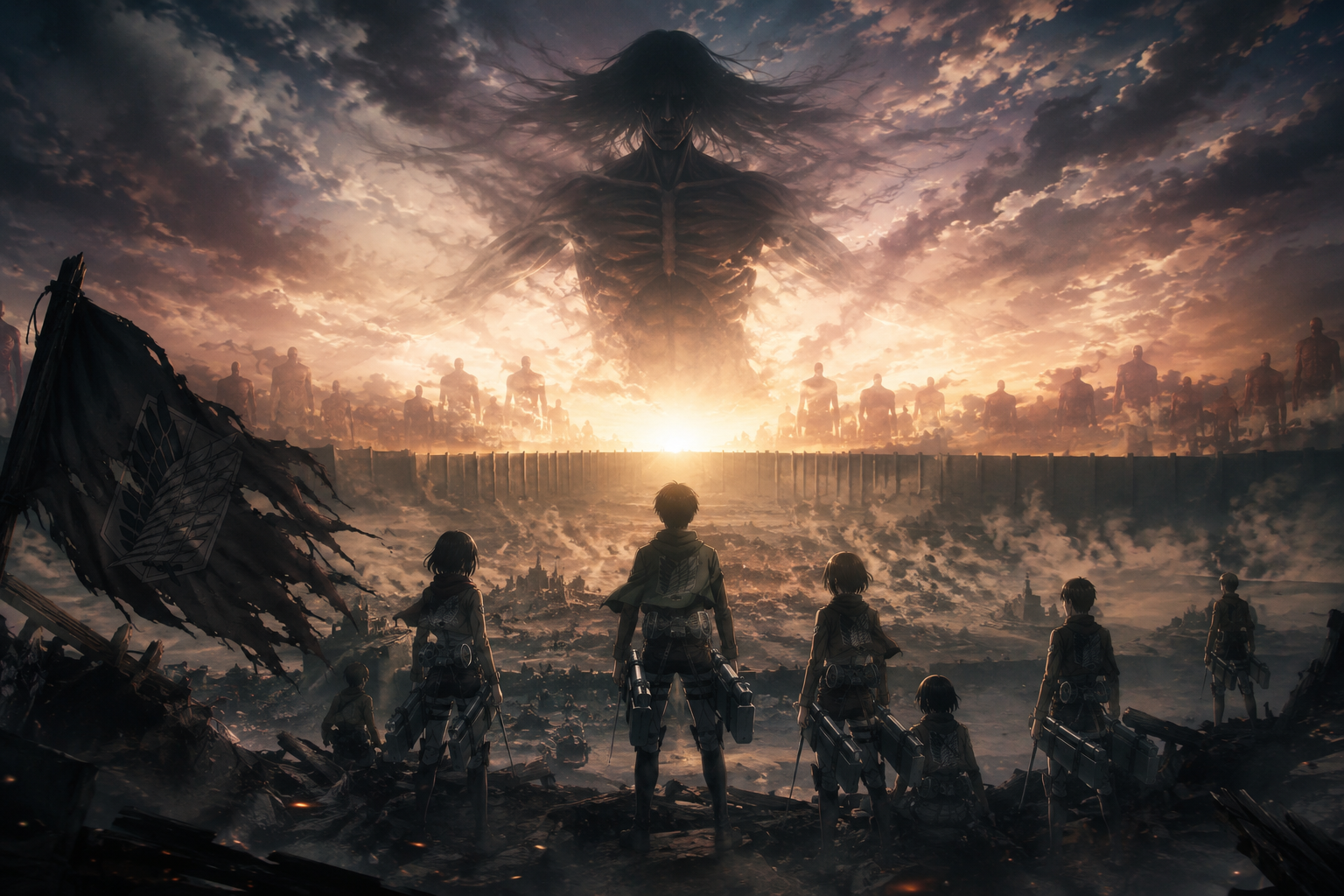
Attack on Titan Finale Explained: The Complete Breakdown
Eren Yeager activated the Rumbling because he saw no alternative. The world’s hatred for Eldians was absolute, diplomacy had failed, and his visions of the future showed only one path that would protect his friends and end the Titan curse. He sacrificed 80% of humanity, his own life, and his relationship with everyone he loved—all to give Paradis a chance at survival and his friends a future free from the burden of Titans.
The finale of Attack on Titan isn’t a conventional victory lap. It’s a philosophical reckoning, a story that forces you to sit with uncomfortable questions about justice, freedom, and what we’re willing to sacrifice for the people we love. Hajime Isayama spent over a decade constructing a narrative that systematically dismantles the concept of absolute morality, and the ending reflects that commitment completely.
Let’s break down exactly what happened, why it happened, and what it all means.
Eren’s True Motivation: The Full Picture
The Three Goals
Eren’s plan wasn’t simple genocide. He had three interconnected objectives:
- Destroy the world’s military forces to render them incapable of attacking Paradis
- Make his friends into heroes who would stop him and be celebrated by the surviving world
- End the Titan curse permanently by forcing Ymir Fritz to finally let go of her 2,000-year servitude
Every action Eren took in the final arc served all three goals simultaneously. The Rumbling was never random destruction—it was calculated chaos designed to achieve multiple outcomes at once.
Why Diplomacy Failed
Eren didn’t start with genocide. He tried everything else first.
The Marley Arc (Season 4, Episodes 1-16 / Chapters 91-105) showed Eren attempting a measured approach. He infiltrated Marley, gathered intelligence, and even tried to understand the enemy. The Declaration of War—when Willy Tybur announced Paradis as the world’s enemy—was Eren’s breaking point. He realized that no amount of diplomacy would overcome centuries of propaganda and fear.
The Alliance’s formation between Paradis and Marley was genuine. Hange, Armin, and others truly believed peace was possible. But Eren had seen the future. He knew that even with the Alliance’s efforts, the world would never accept Eldians. The hatred was too deep, too embedded in generations of trauma.
The Future Memories Trap
Eren’s ability to see future memories through the Attack Titan’s power complicated everything. When he kissed Historia’s hand (Chapter 90 / Season 3, Episode 22), he glimpsed fragments of the Rumbling—the destruction, his friends’ reactions, his own death.
The critical question: Did Eren have a choice?
Isayama’s answer is both yes and no. Eren could have chosen differently, but his personality made other choices impossible. He is who he is: someone who would sacrifice everything for his ideal of freedom. The future memories didn’t force him to act—they showed him what he would choose because of who he already was.
This is determinism without escaping responsibility. Eren made choices, and those choices were inevitable given his nature and circumstances. The paradox is intentional, forcing readers to grapple with the same questions about free will and destiny.
The Rumbling: Anatomy of a Cataclysm
What Actually Happened
Eren used the Founding Titan’s power, accessed through his contact with Zeke (Chapter 120), to command the Wall Titans. Approximately 585,000 Colossal Titans—each standing 60 meters tall—marched across the world, flattening everything in their path.
The destruction timeline:
- Initial activation: The Walls crumbled, releasing the titans into the world
- First phase: Marley’s military installations destroyed
- Second phase: Other nations’ armies and infrastructure targeted
- Third phase: Global devastation reaches 80% of humanity
- Final phase: The Alliance stops Eren at the last moment
The Environmental Impact
Isayama’s attention to detail includes the Rumbling’s ecological consequences:
- Global temperatures dropped by an estimated 4°C
- Agricultural systems collapsed worldwide
- Famine and disease followed the physical destruction
- The dust cloud from the titans’ footsteps covered the sky for months
These details matter because they reinforce the series’ central theme: violence, even when justified, creates chaos that outlasts the initial conflict. Eren achieved his military objectives, but the world he left behind was broken in ways that took generations to heal.
Was the Rumbling Inevitable?
The post-credits scene (Chapter 139) shows a future boy discovering a tree identical to the one Ymir Fritz found. The implication is chilling: the cycle will repeat. Humanity’s nature is unchanging. Even after witnessing the worst destruction imaginable, people will eventually make the same mistakes.
Isayama isn’t being nihilistic—he’s being honest. Peace is never permanent. The work of building a better world is never truly done. That’s why the ending feels bleak. It’s a warning, not a resignation.
Eren and Armin’s Final Conversation: Decoding the Scene
The Paths Meeting
The conversation between Eren and Armin in the Paths (Chapter 139 / Episode 87) is the emotional core of the finale. Eren isn’t a villain monologuing—he’s a broken young man confessing his failures.
Key revelations:
- Eren admits he doesn’t know why he did everything—he simply felt compelled
- He confesses his love for Mikasa, something he repressed to protect her
- He acknowledges that his plan was flawed and imperfect
- He apologizes for being “an idiot who got his hands on too much power”
- He reveals that he tried other paths but saw only this outcome
The “I Don’t Know” Moment
When Armin asks why Eren went so far, Eren’s response is startling:
“I don’t know. I just wanted to do it. So badly.”
This isn’t a cop-out—it’s brutal honesty. Eren has been driven by forces he barely understands: his own nature, the Attack Titan’s influence, the weight of history, and the trauma of his childhood. He isn’t a calculating mastermind; he’s a person who was pushed to extremes and chose a terrible solution because he couldn’t see any other way.
The confession makes Eren more tragic, not less. He isn’t a monster enjoying destruction. He’s a slave to his own nature, just as Ymir was a slave to hers. The difference is that Eren’s slavery was self-imposed—or at least, indistinguishable from his deepest desires.
Why This Conversation Matters
Armin doesn’t condemn Eren. He thanks him for trying to save them, even as he acknowledges the horror of what Eren has done. This is the series’ moral stance in microcosm: understanding isn’t forgiveness. You can acknowledge someone’s pain without excusing their actions.
Armin’s role as the voice of reason is crucial. He represents the possibility of empathy, of seeing the humanity in even the worst actions. That doesn’t make Eren’s choices okay—but it prevents the story from becoming simple condemnation.
Mikasa’s Choice: Breaking the Curse
The Killing Blow
Mikasa’s final act—killing Eren and kissing him—is loaded with meaning. For the entire series, Mikasa defined herself through her devotion to Eren. Her identity was built around protecting him. Killing him represents a complete inversion of that instinct.
The sequence (Chapter 138 / Episode 87):
- Mikasa enters the Doomsday Titan’s mouth
- She sees Eren’s head attached to the spine
- Eren speaks to her one last time through memories
- She kisses him—their first and only kiss
- She severs his head, ending the Titan curse
Why Ymir Was Free
Ymir Fritz spent 2,000 years serving the royal bloodline. She believed love meant obedience. When King Fritz commanded her, she obeyed. When he died, she continued serving his descendants. Her enslavement was psychological, not physical.
Mikasa shows Ymir that love can mean letting go. Mikasa kills the person she loves most not because she hates him, but because she loves him enough to free him from his own destructive path. The kiss is an act of liberation, not betrayal.
The parallel is exact:
- Ymir obeyed King Fritz’s commands out of twisted love
- Mikasa disobeys Eren’s wish to be left alone out of genuine love
- Ymir was trapped by her devotion
- Mikasa is freed by her choice
When Mikasa kills Eren, Ymir finally understands. Love doesn’t require servitude. The curse breaks because someone proved that love and freedom can coexist.
Mikasa’s Afterlife
The final panels show Mikasa living a full life. She marries, has children, and raises a family. She visits Eren’s grave annually, always wearing the scarf he gave her. In her old age, she passes the scarf to her descendants.
Mikasa’s ending represents:
- Freedom achieved through letting go
- The possibility of healing after unimaginable pain
- Eren’s legacy living on through people who loved him
- Breaking the cycle of obsession
- Finding life after loss
The Alliance’s Final Battle: Every Major Character’s Role
Armin Arlert: The Tactician
Armin’s strategic mind is crucial to the Alliance’s success. He coordinates the assault on the Doomsday Titan, using his Colossal Titan form to create openings for the others. His willingness to sacrifice himself—knowing he might die—shows his growth from the fearful boy of Season 1.
Armin’s significance:
- Represents diplomacy and understanding
- His Colossal Titan form helps stop the Rumbling
- Becomes the leader of peace negotiations
- Lives with survivor’s guilt, knowing he couldn’t save Eren
- Exemplifies the series’ insistence on continuing despite trauma
Levi Ackerman: The Veteran
Levi’s role in the final battle is diminished by his injuries, but his presence is still vital. He’s the emotional anchor of the Alliance, representing everything the Survey Corps fought for. When he salutes his fallen comrades, he honors their memory while accepting his own survival.
Levi’s legacy:
- Carries the memories of the Survey Corps
- Represents resilience in the face of endless loss
- His promise to see Eren’s vision through is fulfilled
- Finds purpose in mentoring the next generation
- His survival emphasizes the importance of witnesses to history
Reiner Braun: The Mirror
Reiner’s confrontation with Eren in the Paths (Chapter 133) is one of the finale’s most powerful moments. Reiner doesn’t condemn Eren because he understands the impulse to destroy everyone who threatens the people you love. He did the same thing as the Armored Titan.
Reiner’s arc:
- From child soldier to disillusioned adult
- Carries survivor’s guilt from the destruction of Shiganshina
- Chooses to live with his guilt rather than be consumed
- Represents the possibility of redemption
Gabi Braun and Falco Grice: The Future
Gabi and Falco’s journey from hatred to understanding is the series’ most optimistic arc. Gabi kills Sasha, the fan-favorite, and fans hated her for it. Isayama’s intention was to show that people can change.
Their significance:
- Gabi unlearns hatred through contact with Sasha’s family
- Falco becomes the Jaw Titan and fights alongside his former enemies
- They represent the possibility of breaking the cycle
- Their survival offers hope for future generations
Jean Kirstein and Connie Springer: The Human Cost
Jean and Connie represent ordinary people making extraordinary choices. They’re not warriors or shifters—they’re soldiers who keep fighting despite unimaginable loss. Jean’s survival and eventual role in Paradis’s government show that ordinary people can shape history.
Their importance:
- Demonstrate that heroism isn’t about power
- Their friendship with each other and with Sasha humanizes the story
- Jean’s pragmatic idealism is crucial to the Alliance
- Connie’s growth from comic relief to serious soldier is underrated
Pieck Finger and Annie Leonhart: The Warriors
Pieck and Annie’s choice to fight alongside former enemies is significant. They’re Marleyan Warriors who once saw Paradisians as devils. Their decision to join the Alliance demonstrates that reconciliation is possible.
Their arcs:
- Annie confronts the guilt of her past
- Pieck’s loyalty to her comrades extends beyond Marley
- Both choose personal conscience over national loyalty
The Post-Credits Scene: The Cycle Continues
The Boy and the Dog
The final panels show a boy and a dog approaching a tree identical to the one Ymir Fritz found. The implication is chilling: history will repeat. Another child will discover a strange power. Another era of titans will begin.
The scene’s symbolism:
- History repeats when we forget it
- Human nature is unchanging
- Freedom is temporary
- The past can never be fully escaped
Paradis’s Destruction
A later scene in the volume edition shows Paradis being bombed, civilization rebuilt, and eventually destroyed again. Isayama’s point is devastating: even paradise isn’t permanent. The survivors of the Rumbling are doomed to repeat the mistakes of their ancestors.
This isn’t nihilism—it’s realism. The series never promised a happy ending. It promised an honest one. And honestly, humanity’s track record shows that peace is fragile.
What Comes Next
The final message isn’t hopeless. The boy finding the tree suggests curiosity and wonder—the same qualities that drove Eren to explore beyond the walls. The cycle might repeat, but it also might not. That ambiguity is Isayama’s gift to readers. He doesn’t tell us what to think. He asks us to keep thinking.
Themes and Symbolism: The Deeper Meaning
Freedom and Its Costs
Freedom is the series’ central theme, but Isayama subverts it repeatedly. Characters fight for freedom, only to become prisoners of their choices. Eren’s quest for freedom results in the ultimate slavery—becoming an idea rather than a person.
Freedom is presented as:
- A goal worth dying for
- An illusion in a deterministic universe
- Something that requires sacrifice
- Never absolute—it always limits others
- Achievable only through understanding and forgiveness
The Cycle of Hatred
Isayama doesn’t offer easy solutions. The characters who break the cycle do so through individual choices, not systemic change. Gabi chooses to see Paradisians as human. Reiner chooses to live with his guilt. Armin chooses diplomacy over revenge.
Breaking the cycle requires:
- Acknowledging shared humanity
- Confronting past atrocities honestly
- Choosing empathy over fear
- Accepting personal responsibility
The Nature of Monsters
Who are the real monsters? Titans, or the humans who create them? Marley, or the Eldian government? Eren, or the world that forced him into a corner?
Isayama’s answer: monsters are made, not born. Circumstances create cruelty. Systems generate violence. The responsibility lies not in blaming individuals but in dismantling the structures that create suffering.
Memory and Identity
The Paths realm connects all Eldians through shared memory. We are shaped by those who came before us. Trauma is inherited. Forgiveness requires remembering. Identity can be a burden or a gift.
Ymir’s liberation comes when Mikasa shows her that memory isn’t destiny. You can honor the past without being enslaved by it. That’s the series’ most hopeful message.
Critical Reception: Why the Ending Divided Fans
The Arguments For
Thematic consistency. The ending stays true to everything the series established. Violence has consequences. Freedom requires sacrifice. Love isn’t simple. There are no easy answers.
Character integrity. Eren’s choices, though horrifying, are in character. Mikasa’s final act is heartbreaking but inevitable. Armin’s survival represents hope.
Emotional power. The final confrontation, Eren’s confession, Mikasa’s kiss—these moments land because they’re earned.
Intellectual honesty. Isayama respects readers enough to leave questions unanswered. We’re meant to discuss, debate, and reflect.
The Arguments Against
Pacing issues. The final arc rushes through some plot points, particularly Historia’s role and the immediate aftermath.
Unresolved questions. What exactly happened to Ymir? Why was Historia’s pregnancy so crucial? Some mysteries feel dropped.
Tonal whiplash. The shift from action to philosophical conversation is abrupt.
The “I don’t know” moment. Some readers felt Eren’s motivation was under-explained.
The Verdict
The ending is a masterpiece of thematic writing with some structural flaws. It’s not perfect—no ending could satisfy everyone after eleven years of speculation. But it is true to itself. Isayama stayed committed to his vision, even when that vision was painful.
Rating: 8.5/10
- Thematic ambition: 10/10
- Character consistency: 9/10
- Emotional impact: 10/10
- Structural execution: 7/10
- Re-readability: 10/10
Frequently Asked Questions
Was Eren a hero or a villain?
Neither. He was a tragic figure shaped by circumstances beyond his control. He did monstrous things for what he believed were noble reasons. The series refuses to label him because that’s the point—absolute morality doesn’t exist.
Why did Eren let himself be killed?
Eren planned his own death. By becoming the ultimate villain, he made his friends into heroes. By dying, he ended the Titan curse. His death was always part of the plan.
What happened to Paradis after the ending?
The world’s peace with Paradis was fragile but initially held. Centuries later, Paradis was bombed and civilization collapsed. The cycle of history repeated itself.
Was the ending happy?
No. It was bittersweet, honest, and tragic. Happiness was never the goal—meaning was.
Is there going to be a sequel?
No, Isayama has confirmed the series is complete. The post-credits scene is thematic, not a teaser.
What was Historia’s role in the ending?
Historia becomes queen and gives birth to a child. The father’s identity is ambiguous. Her role is underdeveloped in the final arc, which is a common criticism.
Why did Ymir choose to obey Eren?
Ymir saw herself in Eren—someone enslaved by love and duty. She gave him her power because she recognized a kindred spirit, not because he was the right choice.
What is the Rumbling’s purpose?
Multiple purposes: destroy military threats, make the Alliance heroes, and break Ymir’s curse. Eren needed all three to succeed.
What happened to the other Titan shifters?
The Titan curse ends when Ymir is freed. All shifters revert to human form and live out their lives normally.
What is the final message of Attack on Titan?
Freedom is never free. The struggle for it is what makes us human. Peace is fragile. Hope must be actively maintained.
Final Thoughts: Why Attack on Titan Matters
Attack on Titan isn’t just a story. It’s a cultural phenomenon that challenged anime’s conventions, pushed boundaries, and forced conversations about topics most series avoid. Isayama created a world where no one was safe, where heroism had a cost, and where even the most well-intentioned actions could spiral into atrocity.
What makes Attack on Titan endure:
- Its willingness to explore gray morality
- Its refusal to take easy paths
- Its honest portrayal of trauma
- Its belief in character growth
- Its confidence in leaving questions unanswered
The ending is controversial because it refuses to tell you what to think. It presents a situation—a boy who committed genocide for reasons he barely understands—and asks you to decide how to feel about it. That’s not cowardice. That’s the highest form of respect a creator can show their audience.
Isayama trusted us to think for ourselves. He gave us a story that challenges our assumptions, forces us to sit with discomfort, and refuses to offer easy comfort. In a world filled with stories that tell us what to believe, Attack on Titan stands apart by telling us nothing—and everything.
The final panels show a boy finding a mysterious tree. The cycle might repeat. It might not. The ambiguity is the point. We’ll never know what comes next. But we can choose to hope. We can choose to build something better. That’s the series’ ultimate gift: not an answer, but the courage to keep asking the question.
Did the ending work for you? What do you think Eren was really trying to achieve? Share your thoughts below. I’d love to hear your perspective.
About the Author
A lifelong fan of stories that challenge and inspire, I’ve spent years analyzing the works that define our cultural moment. Attack on Titan is one of the most significant narratives of the 21st century—a story that forces us to confront uncomfortable truths about violence, love, and the nature of freedom. If you share that fascination, feel free to reach out. The conversation is just beginning.